

Top Technology Skills in Demand

As Salesforce CEO Marc Benioff famously said: “Change is the only constant in the technology industry”.
Over the past few years, that has proven especially true as AI continues to reshape the technology landscape. From job descriptions to the way work is performed and assessed, artificial intelligence is transforming technology roles at every level.
It has also given rise to new positions such as AI Auditors and AI Ethicists, reflecting the growing need to balance innovation with governance and compliance.
Our technology recruitment experts across the globe shared their outlook on how these changes are influencing hiring in our 2026 salary guides. Drawing on those insights, this article highlights the top technology skills in demand in 2026.
2026 Skills Snapshot: In-Demand Technology Skills
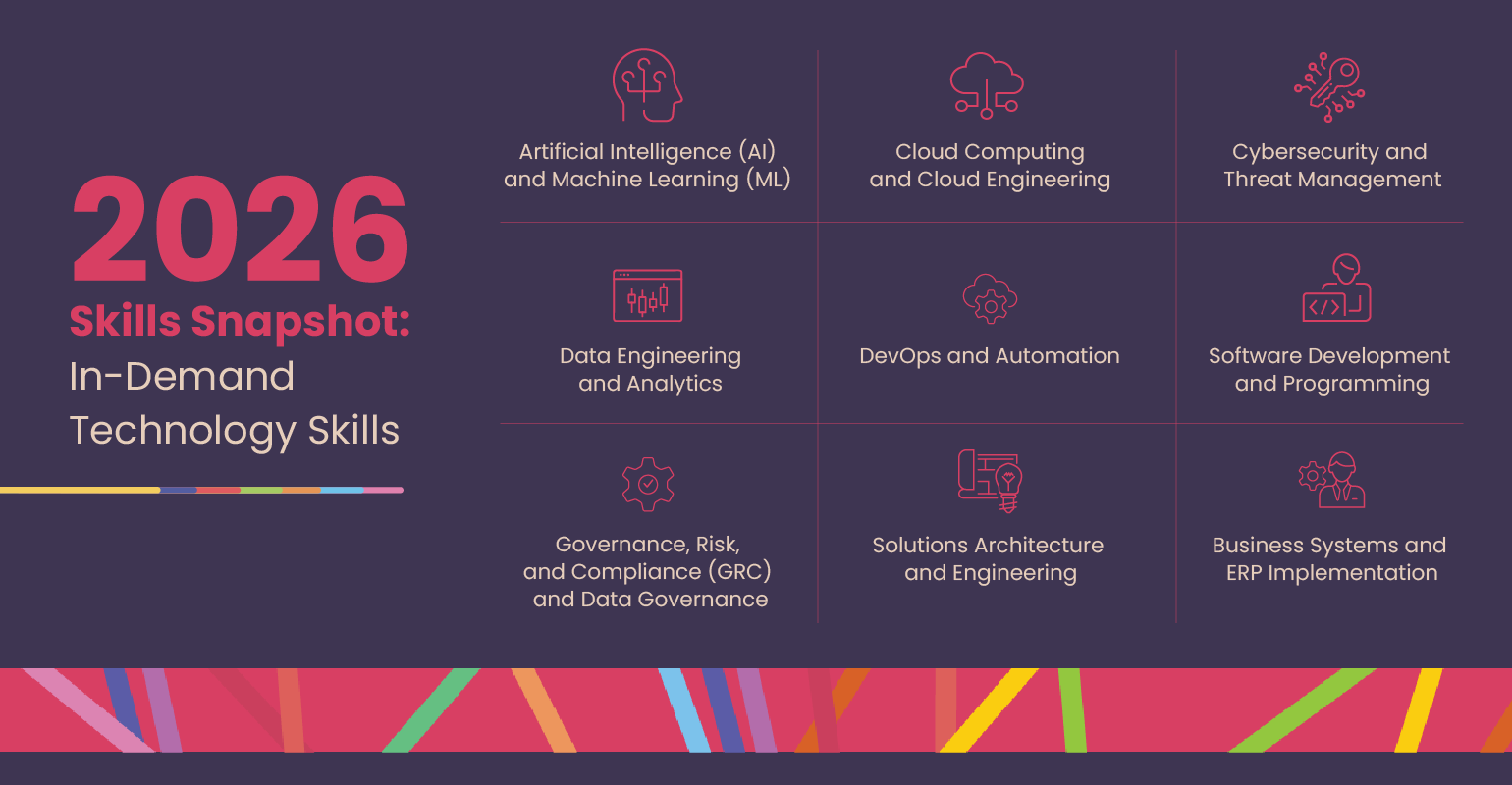
1. Artificial Intelligence (AI) & Machine Learning (ML)
AI and ML are at the heart of digital transformation, and demand for these skills continues to grow across global technology hubs.
Professionals in this space are working on everything from chatbots to fraud detection, recommendation engines, and predictive analytics. Companies are particularly seeking jobseekers who can apply AI models in real-world settings while also navigating the ethical and regulatory considerations that arise.
Key capabilities:
- Frameworks like TensorFlow, PyTorch, and Scikit-learn
- NLP tools such as Hugging Face, SpaCy, and NLTK
- Working with Large Language Models (LLMs) and Retrieval-Augmented Generation (RAG)
- Data science, computer vision, and multimodal AI applications
- Understanding of AI ethics and responsible development practices
In-demand across: Australia, Canada, Hong Kong, Ireland, the UK, Japan, Singapore, and Mainland China.
2. Cloud Computing & Cloud Engineering
Cloud skills continue to be one of the top technology skills in demand, with businesses scaling fast and adopting multi-cloud strategies.
Engineers and architects are expected to design futuristic infrastructure, automate deployments, and keep systems secure, often across platforms like AWS, Azure, and Google Cloud Platform (GCP).
Key capabilities:
- Cloud platform expertise (AWS, Azure, GCP)
- Infrastructure as Code (Terraform, Ansible)
- Serverless computing and container orchestration (Docker, Kubernetes)
- Cloud security, Identity and access management (IAM), and cost optimisation
In-demand across: Cloud expertise is also globally sought after, with high demand in Australia, Canada, Hong Kong, Ireland, the UK, Japan, Singapore, and Mainland China.
3. Cybersecurity and Threat Management
Cybersecurity is a board-level priority now as companies are under pressure to secure their data, infrastructure, and applications, especially with cloud-native environments becoming standard.
Security Engineers, Analysts, and incident response teams are in high demand, particularly in sectors like finance, government, and healthcare.
Key capabilities:
- Threat modelling, intrusion detection, and vulnerability management
- Familiarity with frameworks like NIST and ISO 27001
- Security tools (firewalls, intrusion detection systems (IDS), encryption)
- Cloud security best practices and DevSecOps
In-demand across: Australia, Canada, Hong Kong, Ireland, the UK, Japan, Singapore, and Mainland China.
4. Data Engineering and Analytics
As companies double down on data, they need people who can build reliable data pipelines, clean large datasets, and surface insights through visualisation tools.
Data Engineers and BI Analysts are helping organisations turn raw data into actionable decisions.
Key capabilities:
- ETL pipelines, data warehouses, and cloud data platforms
- Data visualisation tools: Power BI, Tableau
- SQL, Python, and advanced Excel
- Business Intelligence and reporting
In-demand across: Australia, Canada, Hong Kong, Ireland, the UK, Japan, Singapore, and Mainland China.
5. Software Development and Programming
There’s still massive demand for skilled developers, particularly those who can work across the stack, build mobile-first applications, and adapt to new languages and frameworks.
Companies value engineers who combine solid programming skills with product awareness and the ability to work in agile teams.
Key capabilities:
- Programming languages: Java, Python, C++, SQL
- Microservices, RESTful APIs, and back-end development
- Front-end frameworks and mobile app design
- Debugging, testing, and Git version control
In-demand across: Canada, Hong Kong, Ireland, the UK, Japan (specifically for embedded software in industrial / automotive industries), and Singapore (including specific niches like game engineering)
6. DevOps and Automation
DevOps and automation skills remain in high demand because businesses need technology teams that can ship faster without sacrificing stability. As cloud environments grow more complex, employers are looking for specialists who can improve reliability, streamline delivery, and support smoother collaboration across development and operations.
Senior DevOps, DevSecOps, Site Reliability Engineering (SRE), and platform engineering talent is especially valuable because these roles directly affect uptime, performance, and customer experience.
Key capabilities:
- Containerisation and orchestration
- Infrastructure as Code implementation
- Cloud infrastructure management
- Incident response handling
- Performance tuning expertise
- Automation workflow design
In-demand across: Australia, Canada, Hong Kong, Ireland, the UK, and Singapore
7. Governance, Risk, and Compliance (GRC) and Data Governance
New regulations and rising cyber threats are forcing organisations to take risk management more seriously, bringing GRC and data governance skills into strong demand.
As companies expand their use of cloud and AI, they need professionals who can protect data, ensure compliance, and support better decision-making through stronger controls and governance. This has made hybrid talent especially valuable, with employers seeking people who can combine regulatory expertise with analytics and digital risk knowledge.
Key capabilities:
- Regulatory compliance expertise
- Data privacy management
- AI risk awareness
- Cyber risk controls
- Risk data analysis
- FinOps understanding
In-demand across: Australia, Canada, Hong Kong, Ireland, Singapore, and Mainland China.
8. Solutions Architecture and Engineering
With companies needing technical experts who can design scalable systems and also support business goals, solutions architecture and engineering skills are seeing a strong demand.
These roles are especially valuable where product delivery, reliability, and customer experience are closely linked, which is why demand remains strong in markets like Singapore. As organisations continue to build more complex technology environments, they need professionals who can translate business needs into practical technical solutions.
Key capabilities:
- Scalable system design
- Business and technical alignment
- Cloud architecture expertise
- Reliability and performance focus
- Customer-facing solution delivery
- Technical problem solving
In-demand across: Singapore.
9. Business Systems and ERP Implementation
As organisations prioritise digital transformation, process automation, and large-scale system upgrades, ERP and business systems remain a key technology skill in demand.
Companies need specialists who can deliver complex implementations and migrations without disrupting business operations, especially across finance and transformation functions.
Expertise in platforms like SAP S/4HANA, Oracle Cloud, Microsoft D365, and NetSuite is particularly valuable in markets such as Singapore and Japan.
Key capabilities:
- ERP platform implementation
- Systems migration planning
- Process automation delivery
- Finance transformation support
- Cross-functional stakeholder management
- CRM upgrade execution
In-demand across: Canada.
Top Soft Skills Required for Technology Professionals
In the technology market driven by automation and AI, soft skills still make a big difference, especially for those in cross-functional or leadership roles. Employers are looking for professionals who can communicate clearly, collaborate effectively, and stay adaptable in fast-changing environments.
Key soft skills include:
- Communication and storytelling with data
- Cross-functional collaboration and influence
- Problem-solving and critical thinking
- Agility and openness to change
- Business awareness and stakeholder engagement
- Emotional intelligence and team leadership
These soft skills are especially valued in roles like product management, DevOps, and AI strategy, where success often depends on alignment, not just code.
Emerging Technology Skills for 2026 and Beyond
Beyond the core skills driving today's hiring, several emerging specialisations are gaining traction as technology evolves. These niche capabilities reflect new regulations, industry-specific demands, and the rapid integration of AI across sectors. Here's what's on the rise:
1. Digital accessibility expertise: New regulations, such as the European Accessibility Act, are increasing demand for digital accessibility specialists.
2. AI ethics and auditing: The push for responsible AI and compliance with frameworks like the EU Digital Services Act (DSA) has created new niche roles such as AI Auditors and AI Ethicists.
3. Embedded software and automotive technology: In Japan’s industrial and automotive sectors, demand remains strong for specialists with expertise in Embedded C/C++, ADAS engineering, AUTOSAR, and CAE/CAD.
4. Algorithmic trading systems and fintech development: In Mainland China, growth in tech-driven financial roles is driving demand for professionals with skills in high-frequency trading systems, API integration, and fintech product development.
To learn more about the skills in demand for professionals in the technology industry, download your local 2026 salary guide, where you’ll find market overviews, salary trends, and roles and skills in demand in your region.
To get support with your unique hiring needs in technology, get in touch with our experts.