How to Write a CV Using AI: Dos and Don’ts

The traditional golden rules of CV writing are facing their biggest challenge yet. With the rise of generative AI, the job market has seen a massive shift in how candidates write CVs.
Access to AI tools has made CV writing easier and less time-consuming for jobseekers. From a single prompt, they are able to create multiple versions of their CVs tailored for different job descriptions, all within minutes.
But there is a flip side to it. In our Australia Salary Guide, Dominic Bareham, Managing Director at Morgan McKinley Australia, highlighted a growing concern among recruiters. Many organisations are seeing an influx of applications that look perfect on paper, but reveal a significant skills gap during interviews.
The culprit? AI-assisted CV tailoring. This creates a real dilemma for jobseekers. If they don't use AI, their CV might be lost in a sea of near-perfect applications. But if they over-rely on it, they risk their experience appearing exaggerated or robotic.
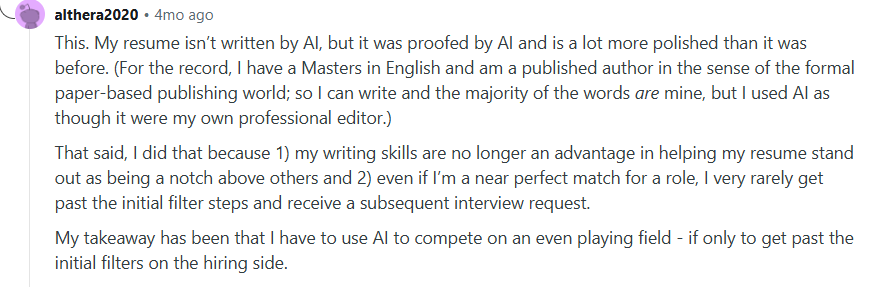
For example, in a recent Reddit thread, a Master's graduate in English shares his experience of having to use AI to compete on an even playing field.
It all comes down to learning how to write a CV that uses AI as a helpful tool, while keeping control of your authentic human experience and skills.
Here are some of our modern dos and don’ts of how to write a CV with AI support for a number of different contexts.
1. Tailoring Your CV to the Job
The Classic Rule: Always tailor your CV to the specific job description, highlighting the most relevant skills and experience for that particular role.
AI Dos: Use AI for your initial drafting and structure. AI excels at pattern recognition, so use it to compare your experience with a job description. Ask it: “What are the top 3 keywords that are currently missing in my CV?” This helps your CV pass through applicant tracking systems (ATS) more effectively.
AI Don'ts: Avoid blind tailoring with AI. Do not ask AI to "rewrite my CV to match this job exactly." This often leads to the AI mirroring the job's language so closely that it feels disingenuous to a recruiter, and it may distort your exact experience.
2. Creating Personal Statements and Summaries
The Classic Rule: Include a compelling, personalised summary at the beginning of your CV to highlight your key achievements and value proposition.
AI Dos: Use AI as a brainstorming partner. Feed it your best achievements and ask it to suggest 3 different ways to structure a 3-line summary. Pick the one that feels most like you and then rewrite it in your own voice.
AI Don’ts: Don't let AI write your personal statement. Recruiters report a surge in corporate words like “leveraging extensive experience to drive innovative solutions.” If your summary reads like a LinkedIn marketing brochure, it will likely be ignored due to it seeming inauthentic.
3. Using Impactful Language & ‘Power Words’
The Classic Rule: Use positive language and power words like launched, managed, and coordinated to describe your work achievements.
AI Dos: Ask AI to suggest stronger synonyms for passive phrases. Turning "I was responsible for a team" into "I mentored a cross-functional team" makes a much stronger impression. Using AI for grammar and spell checks is also good, as it can catch common spelling issues well.
AI Don'ts: Don't let AI over-embellish your achievements. If AI adds a metric, like "increased revenue by 20%" when you didn't provide that data, remove it immediately. That’s a classic case of exaggerating on paper that will only be made evident in interviews.
4. Improving Layout and Readability
The Classic Rule: Use a clear and uncluttered layout. If you use bold text or indentation, keep it simple so the CV is a quick, scannable read.
AI Dos: Use AI formatting tools to check for consistency in your layout, bullet points and date formats. AI is excellent at spotting mismatching font styles, spacing issues, or unusual alignment that a human might miss after hours of editing.
AI Don'ts: Don't use AI to create complex, multi-column CVs. While they look polished, many ATS struggle to read them. Stick to a clean, text-based structure. Also, never submit a CV without a final human review.
AI-generated CVs often exhibit suspicious uniformity, with the same opening verb pattern repeated for every single job. Always have a trusted peer do a final scan to ensure it feels grounded and real.
5. Explaining Career Gaps or Pivots
The Classic Rule: Be transparent about any significant breaks in your career or education.
AI Dos: Use AI to help you draft a concise, professional explanation for a career break. It’s helpful to frame the gap as a period of upskilling or personal development, if relevant, rather than leaving it as “unemployed”.
AI Don'ts: Don't use AI to create fluff or fake roles or qualifications to hide a gap. Recruiters value resilience and honesty over a perfectly filled career timeline.
6. Adding Technical Details and Experience
The Classic Rule: Place important information up-front and use bullet points to describe your major achievements and specific technical competencies.
AI Dos: Use AI to ensure you have included the correct industry keywords. If you are an accountant, for example, AI can ensure you’ve mentioned specific standards that a recruiter's search filter might be looking for.
You can also use AI to generate multiple versions of your experience for different roles. For example, you may create one focused on your data skills and another based on your leadership skills.
AI Don'ts: Don't trust AI with technical facts. AI can hallucinate experience with software or frameworks that didn't exist when you were in the role. In specialised fields like technology or finance, a technical inaccuracy is an immediate red flag that can get your application rejected.
Write a CV That Sounds Like You
When AI efficiency combines with human authenticity, CVs do their job well. As Dominic Bareham noted, looking good on paper is only half the battle; you must be able to back up those claims in person when interviewed.
Use AI to research keywords, refine your grammar, and structure your thoughts, but keep the content, the metrics, and the voice 100% yours. When you master how to write a CV as a human-AI collaboration, you won't just pass the digital filter; you’ll win the human interview.
If you are looking for job opportunities within the many industries that we cover, send us your CV. By joining our extensive talent network, we’ll grant you access to exclusive opportunities before they go to market.