
Workplace AI Trends: 2026 Global Snapshot
The defining shift in 2026 is moving beyond basic AI experimentation to resolving critical governance, skill verification and workforce training challenges.
| AI trend | What the data says | Impact on employer strategy |
|---|---|---|
| Daily workplace AI usage | 62% of employees use AI tools daily at work. | Primary focus has shifted toward strategic planning (27%) and AI output validation (24%). |
| Data and governance risks | 48% of employees use personal AI accounts for work. | Creates exposure to privacy, security, and compliance leaks; 34% of workers lack policy awareness. |
| Candidate AI adoption | 78% of job seekers use generative AI in applications. | Elevated application quality makes skill verification harder for 29% of employers. |
| Human oversight trust | Only 5% of candidates trust automated hiring decisions. | 49% hesitate to apply to pure AI screening; 44% require a "human-in-the-loop" model. |
| Headcount impact | 64% of employers report neutral headcount impact. | Layoff fears are unfounded; 43% explicitly adopt a supportive, "people-first" approach. |
8 Key AI Trends Transforming the Global Talent Market

AI Is Trusted To Assist, Not Decide
While candidates actively use AI to write CVs (59%) and prepare for interviews (43%), only 5% trust AI to make recruitment decisions independently. Trust rises to 44% when AI is paired with human decision-making.
AI Accelerates Applying, Delays Screening
AI-generated applications are flooding candidate funnels. Nearly a third of employers (29%) struggle to verify genuine candidate skills during initial screening, forcing a shift toward practical skills evaluation.
Attitudes to AI in Hiring Differ by Market
Attitudes vary sharply by geography. Asian markets show high trust and adoption (67% CV parsing in Hong Kong), whereas candidates in the UK (28%) and Ireland (35%) are significantly less likely to apply to employers using AI screening.
AI Enables More Strategic Work
Rather than replacing roles, AI serves as an efficiency tool for 70% of employees. Time saved is redirected to high-level strategic planning (27%) and validating AI output (24%).
Personal AI Account Use Is Creating Risk
Nearly half (48%) of workers use personal AI accounts for work tasks. This risk is amplified by a governance awareness gap, where 34% of employees report having no policy or being unsure if one exists.
Replacement Fears Don’t Match Employer Plans
While 46% of employees fear AI job displacement, 64% of employers report zero headcount impact, and only 7% report AI-driven reductions. Furthermore, 43% prioritise a "people-first" model.
AI Adoption Is Outpacing Employee Upskilling
While 52% of employers plan to increase AI training budgets, 58% of employees currently receive inadequate or no training, forcing 30% to self-educate on their own time.
Governance Is Challenging AI Adoption
Data privacy, cybersecurity, and regulatory compliance remain the top barriers to deployment for 25% of employers, despite 55% reporting operational performance gains from AI.
Regional AI Trends Comparison
| Region | Candidate sentiment | Employer AI integration | Key regional insight |
|---|---|---|---|
| Ireland & UK | Highly cautious; 35% (IE) and 28% (UK) are less likely to apply if AI screening is used. | Over 47% (IE) and 55% (UK) avoid AI in hiring entirely. | Candidate skepticism demands strict human oversight and process transparency. |
| Hong Kong & Singapore | High trust; 79% (HK) use AI on CVs; candidate distrust in AI hiring decisions is under 10%. | 67% (HK) and 50% (SG) use AI for automated resume parsing. | Widespread acceptance allows for faster, highly automated talent sourcing. |
| Australia | 41% of candidates use AI to optimise CVs for applicant tracking systems. | 14% automatically reject AI applications (7x the global average of 2%). | High institutional control: 86% of companies maintain formal AI policies. |
| Japan | 78% of employees use AI daily at work (highest globally); only 9% distrust AI hiring. | 42% use AI for CV parsing; 30% of workers use personal AI accounts daily. | Exceptional workplace adoption paired with an urgent need for enterprise governance. |
What You Will Learn in the Full AI Trends Report
Discover the latest employer, employee and candidate plans and preferences data as it relates to:

Practical skill verification:
Adapting your hiring process to accurately evaluate genuine candidate capability beyond polished, AI-generated CVs.
Human-in-the-loop hiring:
Maintaining candidate trust and preventing applicant drop-off by keeping human oversight at key recruitment stages.
AI risk governance:
Closing the policy awareness disconnect and establishing clear guidelines for personal AI account usage at work.
Data-driven upskilling:
Aligning training budgets with core enterprise priorities—specifically data literacy (59%), prompt engineering (55%), and critical output validation.
Balanced governance and operational scaling:
Navigating data privacy, cybersecurity, and compliance obstacles to capture the operational performance gains reported by 55% of employers.
Localised global talent strategy:
Adapting your recruitment approach—balancing high candidate and employer AI acceptance in Asia against elevated skepticism in the UK and Ireland.
About the Global AI Trends Report Research
Conducted in Q3 2026, this study surveyed 2,106 total respondents, (comprising 1,962 employees and 144 employers) across seven global markets: Australia, Canada, Hong Kong, Ireland, Japan, Singapore, and the UK.
The research gathers insights from candidates, professionals, and hiring decision-makers across enterprise and mid-sized organisations in sectors including Financial Services, Technology, Consulting, and Manufacturing.

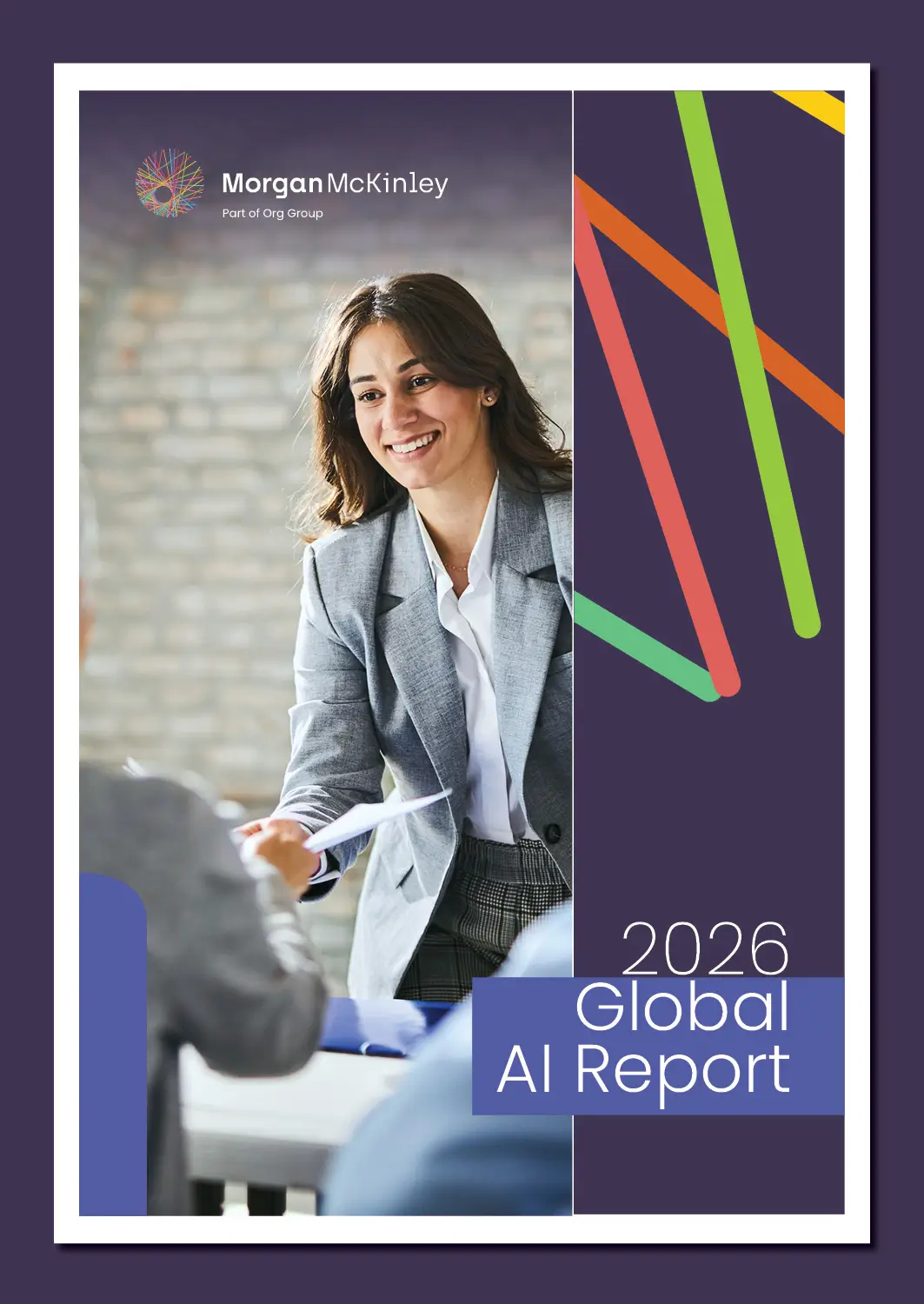
Download the 2026 Global AI Trends Report
Access complete data breakdowns, regional charts, and strategic employer recommendations.
AI Trends: FAQs
How can companies prepare for the workforce of the future?
Companies can prepare by adopting a "people-first" strategy that uses AI to augment human talent rather than replace it, alongside bridging the current training gap where 68% of employees receive inadequate or no AI upskilling.
Organisations must also establish clear governance policies regarding personal AI account usage (currently used by 48% of workers), maintain human-in-the-loop oversight in talent acquisition, and tailor AI adoption strategies to regional candidate trust levels.
What skills do managers need to use AI effectively?
What are the benefits of using AI for employee management?
What ethical considerations should employers consider when implementing AI in the workplace?
How can AI improve workplace decision-making?
What are the benefits of using AI in HR management?
[gated-download-break title="Our 2026 Global AI Report: 8 Key Workplace AI Trends" description=""]
Our 2026 Global AI Report: 8 Key Workplace AI Trends

